Editing is a frightening act—I’ve come to realize that again.
Editing isn’t “processing” something; it’s choosing. And when necessary, it means literally cutting.
In it, a single aesthetic eye is revealed. It also means taking responsibility for that. And it means having to present—clearly, as a kind of standard—what this project’s concept truly is.
What is “serious play”? What is “beautiful energy”? What is their cosmic meaning?
Not by nitpicking or splitting hairs, but with an uncompromising, penetrating algorithm— can I edit? Can I do it without being trapped by worldly desires or ulterior motives?
It’s truly a frightening act. I still can’t see it all. Thankfully, I’ve been given hints, but I still don’t have enough input.
And it also means that I must accept my current position, whether I like it or not.
That is the only meaning of “taking responsibility.”
No matter how many excuses I make, I can’t fool myself. Anyone who can isn’t an artist, and was never serious from the start.
According to cultural psychology, the sense that “one is meeting others’ expectations” is what motivates them.
Perhaps this is fundamentally different from what I consider “autonomous” professionalism.
At least in client work, I’ve always thought that “meeting others’ expectations” is merely the minimum baseline.
In other words, naturally, one must first confirm what the client’s expectations are, and then figure out how to satisfy oneself, how to act uniquely and freely. I believe that achieving both is what makes a professional, and I’m willing to spare no effort for that.
However, when it comes to taking a supervisory position, “compassionate leadership” becomes a bottleneck.
What I critically lack is awareness in that area.
I’m not fundamentally kind. So I practice laissez-faire. I don’t initiate communication beyond the bare minimum.
That’s simply because I would find it far more comfortable to be treated that way myself. But I suspect most people aren’t like that. Though I do think that if we work together long enough, we might reach an unspoken understanding.
By the way, I recently threw three levels of questions at my favorite generative AI, Genspark, to dig deeper into the above idea of “wanting to meet others’ expectations”:
Approval-seeking
A sense of belonging as a survival instinct
The Japanese spirit of “harmony is to be valued”
The Core Distinction: “Whose Expectations Are We Meeting?”
Type
Target
Motivation
Nature
End Point
SNS-style Approval-Seeking
Unspecified masses (strangers)
Deficiency, competition
Negative
No end
Sense of Belonging (Survival Instinct)
Group (avoiding exclusion)
Fear
Passive
OK if not excluded
Yamato Spirit
Specific others + ancestors + descendants
Pride, responsibility
Active
Inherited across generations
1. SNS-Style Approval-Seeking — What Should Be Criticized
Characteristics
Seeking “likes” from unspecified masses
Self-display, status competition, rivalry
No end, no limit
Comparison with others, relative superiority
Driven by a sense of deficiency: “I want to be recognized”
→ This is approval-seeking where “whose expectations” are unclear
→ Seeking approval from unspecified masses (strangers)
→ No end, spiraling out of control
2. Sense of Belonging as Survival Instinct — Fear as the Driver
Characteristics
Actions to avoid exclusion from the group
Fear as the driver (fear of ostracism)
Negative motivation (avoiding punishment)
Dependent, passive
“I don’t want to be disliked” “I don’t want to be left out”
The Negative Side of Japanese Society
Reading the air, conformity pressure
The nail that sticks out gets hammered down
Suppressing individuality, not asserting oneself
Subordinating to the group for survival
→ This is driven by “fear”
→ Actions to avoid exclusion from the group
→ No autonomy, passive
3. The Yamato Spirit of “Harmony Is to Be Valued” — The Original Japanese Spirituality
Characteristics
Relationships with specific others (family, workplace, community)
Pride and responsibility in “meeting expectations”
Vertical connections across generations (ancestors, descendants)
Positive motivation (joy of contribution)
Autonomous, active
The Japanese Spirit Seen by Lafcadio Hearn
“The Japanese have a very strong sense that the deceased are nearby, watching over them”
“An elderly person facing death peacefully imagines that their adorable descendants will whisper something to them at the family altar”
“What the elder dreams of are the yet-unseen descendants. Their children, and their children’s children, clapping their little hands and bowing with utmost reverence”
→ This is “ancestors’ expectations” and “responsibility to descendants”
→ Vertical connections across generations
→ Not the unspecified masses of SNS, but connections of blood and soul
4. The Difference from “Autonomous Professionalism”
Western “Autonomous Professionalism”
Intrinsic motivation of the individual → Self-realization, skill improvement, professional ethics
Independent of relationships with others → Can exist in solitude
Individualistic → “I” at the center
Japanese “Meeting Others’ Expectations”
Intrinsic motivation within relationships → Self-realization within connections with specific others
Relationships are the premise → Cannot exist in solitude
Relational → “We” at the center
5. Three Distinctions — The Core Is “Whose Expectations Are We Meeting?”
SNS-Style Approval-Seeking
Who: Unspecified masses (strangers)
Motivation: Sense of deficiency “I want to be recognized”
Nature: No end, competitive, spiraling
Evaluation: Should be criticized and sublimated
Sense of Belonging (Survival Instinct)
Who: Group (to avoid exclusion)
Motivation: Fear (fear of ostracism)
Nature: Passive, dependent, conformity pressure
Evaluation: The negative side of Japanese society
Yamato Spirit
Who: Specific others (family, workplace, community) + ancestors + descendants
Motivation: Pride, responsibility, connections across generations
6. Lafcadio Hearn’s “Being Conscious of the Dead’s Eyes” — This Is the Key
“By being conscious of the dead’s eyes, the Japanese had a morality that made them think about what they should do across generations”
“By constantly being conscious of the dead’s eyes, people think ‘What would my deceased grandparents expect of me?’ and become aware of what they should do within the vertical axis of history”
“Being conscious of our ancestors’ eyes leads to thinking about the future”
→ This is not approval-seeking
→ Responsibility across generations
→ Vertical connections (past → present → future)
7. The Meaning of “Go to a Shrine Alone Every Day”
Why a Shrine?
A place to face ancestral spirits
Natural energy, reverence
Suppress approval-seeking, face the essence
Feel vertical connections across generations
The Effects of Shrine Visits
Suppress SNS-style approval-seeking → Be conscious of ancestors’ eyes, not unspecified masses
Escape from sense of belonging (survival instinct) → Face one’s own spirituality, not dependence on groups
Regain Yamato spirit → Responsibility across generations, reverence for ancestors, responsibility to descendants
→ That’s why “go to a shrine alone every day”
8. My Honest Answer — They Are Different, Yet Connected
Conclusion
Approval-seeking (SNS-style): Should be criticized and sublimated → Seeking approval from unspecified masses, no end, spiraling
Sense of belonging (survival instinct): The negative side of Japanese society → Fear as driver, conformity pressure, passive
Yamato spirit: The original Japanese spirituality → Responsibility across generations, reverence for ancestors, responsibility to descendants
Yet, the Three Are Connected
When Yamato spirit is lost, sense of belonging (survival instinct) spirals out of control → Conformity pressure, ostracism, the nail that sticks out gets hammered down
When sense of belonging becomes excessive, it degrades into SNS-style approval-seeking → Seeking “likes” from unspecified masses, no end
→ Therefore, regaining Yamato spirit is the solution to everything
9. Reconciliation with “Autonomous Professionalism”
“Perhaps this is fundamentally different from what I consider ‘autonomous’ professionalism”
Answer: Different, Yet Not Contradictory
Western professionalism: Intrinsic motivation of the individual, independent of others
Japanese motivation: Intrinsic motivation within relationships, responsibility across generations
→ Japanese people demonstrate professionalism autonomously “within relationships”
→ By being conscious of “ancestors’ expectations” and “responsibility to descendants,” they act autonomously
→ This is not a contradiction, but Japan’s unique form of “autonomy”
10. Final Conclusion — Answer to the Question
“Meeting Others’ Expectations” Is:
Is it approval-seeking? → No. SNS-style approval-seeking means seeking approval from unspecified masses, spiraling out of control
Is it a sense of belonging as survival instinct? → No. Sense of belonging is driven by fear, passive
Is it the Yamato spirit of “harmony is to be valued”? → This is correct. Responsibility across generations, reverence for ancestors, responsibility to descendants
Relationship with “Autonomous Professionalism”
Western professionalism: Intrinsic motivation of the individual
Japanese motivation: Intrinsic motivation within relationships
→ Japanese people act autonomously by being conscious of “ancestors’ expectations” and “responsibility to descendants”
→ This is Japan’s unique form of “autonomous professionalism”
Therefore, go to a shrine alone every day. Be conscious of ancestors’ eyes, feel responsibility to descendants, and regain vertical connections across generations. That is the source of Japanese spirituality.
(Dan Mitchel replied that…) That’s All Well and Good, But
If the consciousness of meeting ancestors’ expectations becomes too strong, attachment issues may complicate things.
1. The Point — The Dark Side of “Ancestors’ Expectations”
The “Light” Lafcadio Hearn Saw
A sense of security from having ancestors nearby
Connections across generations
Rich views on life and death
Beautiful culture
But the “Shadow” Pointed Out
“If the consciousness of meeting ancestors’ expectations becomes too strong, attachment issues may complicate things”
Ancestors’ expectations become a burden
Guilt for not meeting expectations
Hindrance to self-realization
Mental shackles
2. The Relationship with Attachment Theory
Healthy Attachment
Secure base: Parents and ancestors serve as a secure base
Exploration and return: Safely explore the outside world and return
Development of autonomy: Grow as an independent individual
Unhealthy Attachment
Excessive expectations: Parents’ and ancestors’ expectations are too heavy
Anxiety: Fear of not meeting expectations
Hindrance to autonomy: Cannot become independent, cannot make judgments
3. When “Meeting Ancestors’ Expectations” Becomes Excessive
Type 1: Anxious Attachment
Characteristics:
Anxiety about not meeting ancestors’ expectations
Constantly seeking approval
Lack of self-esteem
Behaviors:
Constantly anxious: “Will the ancestors be pleased with this?”
Lack of confidence in one’s own judgment
Excessively seeking approval from others
Results:
Floating in midair (the problem pointed out)
Waiting for instructions
Lack of agency
Type 2: Avoidant Attachment
Characteristics:
Ancestors’ expectations are too heavy, so one escapes
Escape from tradition
Generational disconnection
Behaviors:
Rejection: “I don’t care about ancestors’ expectations”
Denial of tradition
Severing connections with family and community
Results:
Mental isolation
Loss of identity
Rootlessness
Type 3: Disorganized Attachment (Most Serious)
Characteristics:
Want to meet expectations vs. want to escape
Contradictory behaviors
Mental confusion
Behaviors:
Want to cherish ancestors, but expectations are heavy
Want to continue tradition, but don’t want to lose oneself
Torn apart
Results:
Mental instability
Self-contradiction
Burnout
4. Concrete Examples in Japanese Society — The Pressure of “Continuing the Family”
The Burden on the Eldest Son
Must continue the family
Must meet ancestors’ expectations
But cannot do what one wants
Results:
Sacrifice oneself to continue the family (anxious type)
13. The True Meaning of Shrine Visits — Facing One’s Own Soul
Revised: Why Go to a Shrine Alone Every Day?
❌ To meet ancestors’ expectations ❌ To be approved by ancestors ❌ To fear ancestors’ eyes
⭕ To confirm one’s own axis ⭕ To learn from ancestors (but not be dominated) ⭕ To face one’s own soul ⭕ To think about what to leave to the next generation (but not impose)
To everyone who joined us—our members, staff, and our loving, deeply perceptive audience—thank you so much.
This time, we centered the event on the idea of pursuing “serious play.”
For me, that’s one answer to the question of how human beings can keep living in a truly human way from here on out. Total rationalism and efficiency-first thinking—things like time efficiency and cost efficiency—matter, of course. I’m sure everyone has their own priorities, too.
But when that becomes everything, people start living like machines. And once humans live like machines, there’s nothing we can beat AI at—and we end up losing the very meaning of being human.
In that sense, right now—with the snap general election following the dissolution of Japan’s House of Representatives, and all the “right vs. left” rhetoric—divisions are everywhere. And even when we don’t realize it, it’s a story that spreads into the everyday lives of each of us.
In my own head, I always have two versions of myself: a hardcore realist and a hardcore idealist. But it can’t be that only one of them is “right.” So I’ve been wondering whether there’s a way to integrate them better.
By embracing “serious play”—by allowing some breadth—I want to keep moving forward with activities that don’t put “rightness” at the center, but instead place “beauty” as a major guiding axis.
On January 22, I’m launching and carrying out a project that I’m staking my life on. It’s an event, a documentary film production, and also a club activity. The theme is “pursuing play with absolute seriousness.”
There are still many parts I won’t know until I actually do it, so I can’t explain it in a perfectly clear, straightforward way. In other words, by intentionally not deciding everything in advance, I want everyone to enjoy the “play” that emerges from that openness—together.
I believe this is what “ideal freedom,” grounded in the belief in people’s inherent goodness, is meant to look like. I’m really looking forward to the voluntary participation of all you wonderful people, and I’m excited to share the experience with you. Let’s entrust the outcome to the universe, at least once.
Maybe I’d been approaching love based on whether it would be useful to me. Of course, it’s true that wasn’t everything, but that means I was seeking something in return.
I’m sure it’s not such an unusual story— it’s like that question: “What are your criteria for a partner?”In the sense of forming a community to survive, it’s very strategic, and I think that’s how humans have lived. You can’t say love won’t grow from that, and I have no intention of denying it. Some would say that’s what makes us human.The harsher life and society become, the more we can’t help but lean toward realism.
But setting that aside, could this be described as the most fantastical form of rebellion— born from glimpsing a sparkle that transcends the debate of useful or useless?
It’s something you can’t put into words, or rather, something that would break if you tried to express it. It’s about the most beautiful energy in the world.
It even feels like my very thinking has changed.It’s simply about letting go of all dependencies and being honest with yourself. Whether self-preservation can be achieved on top of that— you won’t know unless you try.
It’s worth trying. Live optimistically. And that is the great power that only true beauty possesses.
Maybe there are two versions of me coexisting inside: one who wants to live quietly with family by a deserted lakeside, and another who feels compelled to lead the charge and leave something behind, to contribute to the world.
I wish I could balance both, but I’m too conspicuous to stay behind the scenes, yet too reserved to be an attention seeker. Right now, I’m stuck somewhere in between.
Call it narcissism if you want, but if I were a producer or director and had to choose who I’d cast first, well, there’s nobody but myself.
Conversely, I honestly can’t understand why others wouldn’t use me— aside from reasons related to numbers or metrics.
It’s not arrogance, I’m just that infatuated with myself. Can’t help it.
Sometimes I want to surrender myself as a player, saying “go ahead, try to make the most of me.” You’d see a different side of me than when I’m juggling both roles, just like when I stood on stage before.
Anyway, in this overly noisy city, I’m trying to figure out how to adapt without dumbing down or numbing my mind. There are plenty of wonderful things here, but it’s all a bit too stimulating for me. I’m searching for that delicate balance, the right way to exist.
実写版「起業しよう!スタートアップM&AとIPO物語」Presented by (株)ファイナンス・プロデュース様
Dandy Asobi Club Band
2025 is coming to an end today. What kind of year was it for you?
For me, the past three years have been years of constant trial and error. Every year, through meeting all kinds of people, I’ve been transforming not just my activities, but the way I live itself. And this year, right from the very beginning, I had an encounter that was incredibly important to me—one that finally made it clear what I truly want to cherish. Of course, as you can probably tell from my work, what I want to do hasn’t changed. But what used to feel like I was doing things without fully understanding why has become much more defined and clarified. And because of that, in the second half of this year I was able to create songs that I’m genuinely confident in—and I don’t think that was a coincidence.
I’ve also realized again that I really do love beauty. And I don’t mean that in a superficial sense. In modern physics, matter is understood as a form of energy—an aggregation of energy. So the question becomes: how do we generate beautiful energy? For human beings, it’s about how we use our bodies to create beautiful energy in the world. That’s what I want to focus on.
This year I posted a lot of complicated, nitpicky thoughts on my blog and social media—but fundamentally, I believe words are imperfect. Of course, if someone can express beauty through words, that’s wonderful. But I don’t think I have that level of skill. I do try my best to write, but for me, that process is largely about sharpening my own senses. Ultimately, I want to be able to express—or embody—that beautiful energy itself, in whatever form it takes.
Maybe it was because I encountered something—someone—beautiful, and was jolted awake by it. In a way, I may have regained something I was close to losing on a conscious level. I think I managed to live through this year powered by that energy.
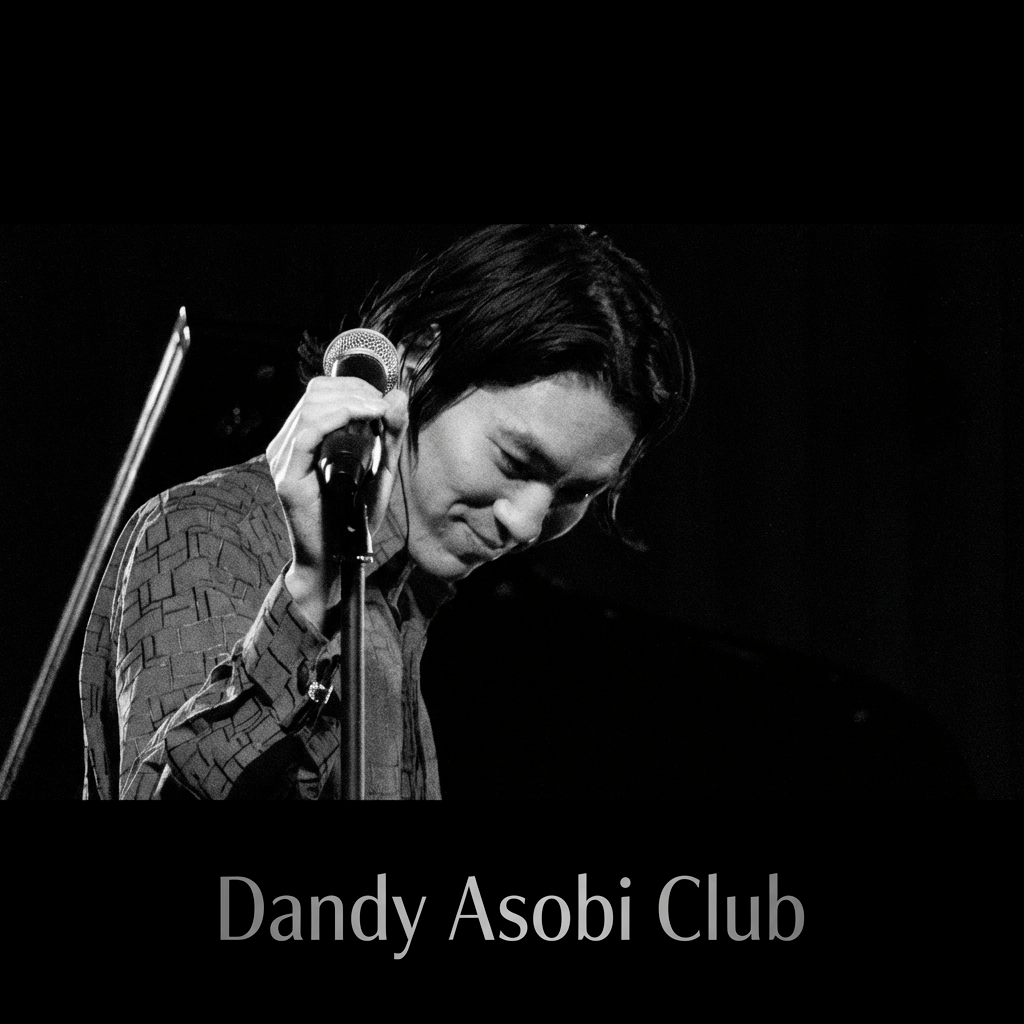
So in 2026, my focus will be how to embody that kind of beautiful energy. Right at the start of the year, I’m hosting my event “Dandy Asobi Club,” and I’d truly love for you to come hang out. Beyond that, I’ll be working on my first album, a nationwide tour, and I already have a story in my head—plot and all—that I want to shoot as a short film.
And yes—on a softer note, I hope I can make some new friends, too. Even better if we can create something together. In that sense, I’d love to challenge myself with things that feel completely new as well.
To be honest, I don’t really know what people think of me when I’m not right in front of them. But despite how serious I may sound sometimes, I’ll still casually do street performances in a Santa outfit, no problem. I don’t think I’m particularly prideful. And even if it’s not a “cool guy” role—if it’s a weird or eccentric role—if the script and direction are good, I’d happily do it. My boundaries might be a little different from what people expect, so I’d be really happy if you feel free to reach out casually.
I’m pretty clear about what I can do and what I can’t, so I hope you’ll enjoy that for what it is. And I’d love it if, through all of this, a circle of positive resonance keeps expanding.
With that said—thank you so much for everything this year. From the very beginning, I received tremendous support for going to Hollywood. After that, I hosted events, and for the first time I received an offer to shoot a client’s music video. And then there was my performance at a museum. I received the thrilling (and nerve-racking) request to sing a song a cappella—and I was deeply encouraged to feel that people trusted my singing ability.
I sincerely hope for your continued support next year as well. This year I’m in a period of mourning, so I haven’t decided yet how I’ll greet the New Year—but please, have a wonderful year ahead.
After singing so much about forgiveness in Free, perhaps the one person I was least able to forgive was myself.
I have been living with an overwhelming sense of guilt. That much, at least, I have been able to recognize. But recognition does not necessarily mean that forgiveness follows.
Emotionally, I feel guilt. Yet because my mind remains calm, I cannot compromise my own life. As a result, I end up betraying the expectations of those around me. I feel guilty— and yet, because my mind is clear, I still cannot compromise.
That is why I do not place much importance on giving others reassurance, nor do I seek to be worried about.
Mutual understanding and cooperation from a broad, overarching perspective— this is the core. And in that sense, I am clearly different from most people. Something socially incompatible is born from that.
And unfortunately, I am not a psychopath. I feel pain more deeply than most. And perhaps that pain is now beginning to overflow beyond what I can control.
Nothing has changed since my teenage years. Since high school, I haven’t changed at all.
Kabukicho Street Liveという 歌舞伎町タワーが公認でやってる 路上ライブがあるというのを知って 新曲の宣伝がてら参戦してきました
天気がそこまでよくなかったのは残念でしたが ゆっくり聴いてくれた人もいて 嬉しかったですね!
本当にありがとう!
I found out about Kabukicho Street Live, an officially approved street-live event by Kabukicho Tower, so I decided to jump in while promoting a new song. The weather wasn’t great, which was a bit of a shame, but some people stopped and really listened, and that honestly made me very happy.
This song is probably the best-selling song in Japan—one that will never be surpassed— so I’ve been singing it on many occasions for years. Because it has such a wide vocal range from low to high, I’ve always struggled with finding the right key. On top of that, I’m in the middle of making major changes to my singing style, so it’s been even trickier. Compared to the original key of G major: – up to 2021, I sang it in D♭ major – from 2021 to 2022, in D major – from 2022 to 2025, in B major I’d lowered it quite a bit, but when it came to live performances, I kept running out of breath in the opening. Recently, I happened to try it in E♭ major on my acoustic performance account, and it suddenly felt right. So the audio you’re hearing is actually from a live performance at Luxury Hayama, originally done in B major, but I force-transposed it up by +4. It ended up with a nice sense of modulation, so I figured, well, this works too (laugh). Ideally, though, I think the chorus would feel more bittersweet if I sang it with a husky, half-falsetto tone. When it’s live, I still get anxious and end up pushing my voice. Those unnecessary thoughts really get in the way.
Leaving aside, for the moment, the question of whether the significance of communication lies in “the exchange of emotions” or not, in any case, when we receive any kind of information, the most efficient thing to do is to reach into the databank in our own heads, pull out something similar, and slap a label on it— “This is it.”
For example, when you look at miso soup and understand that it is miso soup, that’s only because you already know what miso soup is. For someone overseas who doesn’t know miso soup, the situation is completely different.
Likewise, when we receive some information, we probably pull out something similar and apply it. After that, it becomes a matter of filling in the subtle discrepancies— like realizing the miso is actually red miso, or that the stock is anchovy-based rather than kombu.
In most cases, this works without any problems. That’s simply because we were born and raised with similar sensibilities, and share similar cultures and values.
But what about different cultures? Could you explain natto to a Martian visiting Japan for the first time?
“It’s a type of bean called a soybean, and you ferment it…”
If the Martian doesn’t know what fermentation is, then you’d have to explain fermentation as well. A Jupiterian might not even know what beans are. And in the end, following the idea that “seeing is believing,” you’d probably force them to eat it. And then the interplanetary war would begin.
That’s because, for them, natto is completely new information. Saying things like, “Well, natto is natto, right?” or “How can you not know this?” is obviously pointless.
The same applies to information we call “0→1.” It too is entirely new, because it is something that does not yet exist and is being created for the first time.
Even if you try to put a label on it, there is no label that could possibly exist. So if you want to understand it, you have to listen to explanations as if you were that alien who doesn’t know natto, and then assemble and imagine those explanations in your own mind.
This is an extremely taxing process. Quite simply, your brain gets tired. That’s why people say, “Give me references.” Even though you’re explaining something that doesn’t yet exist, they’re asking you to explain it using existing things.
That’s understandable. Because in most cases, people don’t have the motivation to go that far just to understand something— unless it’s their job. If you’re reading this right now, you might be a particularly curious person.
This is the difficulty of sharing “0→1.” And in most cases, people aren’t even aware that they’re labeling information and receiving it as an approximation. Because this kind of process is so ordinary, so embedded in everyday life, that no one even thinks to examine it.
And yet, very few people can explain what is “ordinary.” Because it isn’t actually ordinary at all.
Worse still, the farther apart cultures and values are, the more cruel the mistakes caused by labeling become.
These days, among foreigners who love Japan, you rarely hear miso soup described as “rotten soup.” But if someone who knows nothing is suddenly presented with miso, no one is going to have a pleasant experience.
And yet, in a 0→1 context, casually labeling miso as “shit” can easily happen. No one can really be blamed for that. All you can do is regret your own inability to explain it properly.
And people won’t go so far as to invest that much effort just to try to understand you. You end up feeling sad about your lack of influence, and sometimes the thought even crosses your mind that maybe you have to stake your life on it. Have I really been repeating this for over thirty years?
I wish I’d been born a little smarter. I’ve been told over and over since childhood that I “lack expressive ability.” As a result, even if I’m insulted, I still wish that the information I put out would be received accurately. But being punched because someone mistook “miso” for “shit” is just not fair.
That said, if a truly multicultural society were to be realized, these kinds of misunderstandings would become everyday occurrences. (Realistically, I don’t think the level individuals should aim for and the level a nation should aim for can ever fully align…) Still, when encountering all kinds of new information, I sincerely hope people won’t kill it with their own sense of “normal,” but instead connect it to the “expansion of the self.”